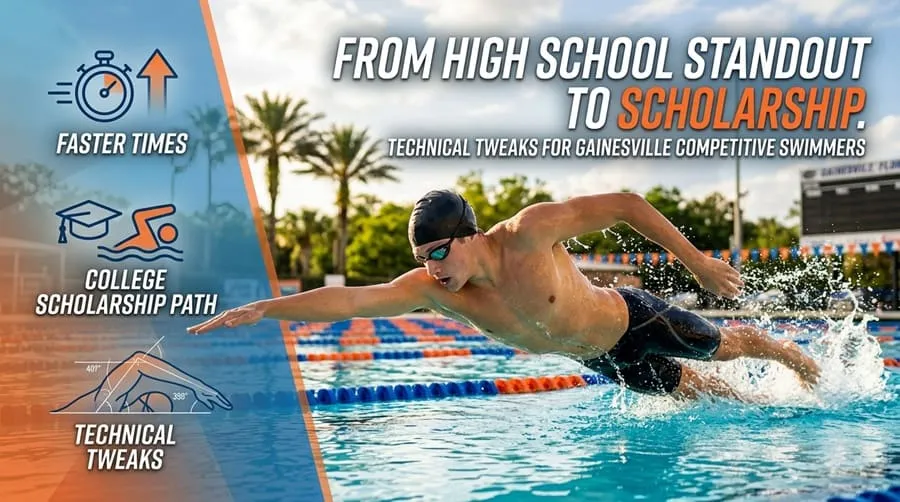
As race times get faster, small technical details become easier to overlook and harder to fix during a crowded practice. Focused work on strokes, starts, turns, underwaters, and breakouts can help a Gainesville swimmer present a more complete picture during the college recruiting process.
Technique matters alongside training
Team practice supplies conditioning, race-pace work, accountability, and experience competing under fatigue. Those pieces are essential. Technical coaching has a different job: give one swimmer enough attention to understand a specific movement and practice a correction.
The two approaches work together. A swimmer can use private coaching to isolate a technical priority, then take the correction back to regular team training and learn to hold it under a full workload.
Start with the catch and body line
A dropped elbow, straight-arm pull, or unstable head position can change how effectively a swimmer holds water. Body alignment matters too. When the hips fall or the stroke moves from side to side, the swimmer may create resistance that extra effort does not solve.
Video and direct observation can make these details visible. The coach and swimmer can then choose drills and cues aimed at the actual pattern rather than guessing from the final time.
Give walls and underwaters real attention
Starts, streamlines, turns, underwater kicks, and breakouts are part of every short-course race. A rushed approach to the wall, loose streamline, or poorly timed first stroke can interrupt speed even when the surface swimming is strong.
These transitions are trainable. A focused session can break them into smaller pieces: approach, tuck or turn timing, contact with the wall, push-off position, underwater rhythm, and the move into the first stroke.
Find a sustainable stroke rate
More strokes do not automatically mean more speed. A swimmer has to balance stroke rate with the distance and control produced by each stroke. The right balance may also change across events.
Private stroke analysis gives a coach time to compare timing, body position, and efficiency at different efforts. The purpose is not to impose one universal tempo. It is to help the swimmer understand which mechanics remain dependable when race pace increases.
Practice technique under fatigue
A correction that appears during an easy drill still has to survive the back half of a race. Once a swimmer understands the movement, team practice becomes the place to repeat it through longer sets and harder efforts.
That transfer should be deliberate. The swimmer can carry one or two simple cues into practice and notice when the old pattern returns. Clear priorities are easier to repeat than a long list of corrections.
Use private work to complement the team
Group coaches have to manage the whole practice: safety, intervals, the training plan, and many athletes at once. One-on-one work creates space to pause, replay video, ask questions, and repeat a small part of the stroke without holding up a lane.
For a Gainesville athlete approaching a tryout or recruiting conversation, swim team prep can reinforce the four strokes, body position, streamlines, breathing, timing, and lap-swimming confidence. It does not replace the swimmer’s team; it gives the athlete another setting for focused technical development.
Prepare a clear picture of progress
Recruiting decisions involve more than a single practice or technical session, and no coaching program can promise a scholarship. Swimmers can still prepare thoughtfully by training consistently, learning to describe their goals, and using race results and video to show how their swimming is developing.
The useful question is not whether one tweak guarantees an outcome. It is whether the swimmer understands the details that can be improved and has a plan for practicing them.
Ready for focused technical feedback in Gainesville? Book a private SwimTec session and bring the events or skills you want to examine.